
A pediatric dental airway evaluation looks at the structures of your child’s mouth and jaw, along with breathing and sleep patterns, sleep habits, and facial development. A virtual visit can help identify concerns that may warrant further evaluation, review your child’s history, and determine whether an in-person dental assessment or referral to another healthcare provider may be appropriate.
Dr. Carla Yamashiro has practiced dentistry in Washington for 23 years. She holds an Integrative Biologic Dental Medicine Certificate and a Naturopathic Physician Certificate. Her practice focuses on dentistry, and her additional training informs how she considers the relationship between oral health, facial structural development, and breathing.
Parents often seek an evaluation because they have noticed snoring, mouth breathing, restless sleep, or other changes and want to understand whether these symptoms may be related to their child’s oral development. Others have concerns that have not been fully addressed during previous appointments.
A virtual dental second opinion can be a convenient starting point. It allows parents to discuss their concerns, share relevant records and observations, and learn whether an in-person examination or further assessment would be helpful.
The goal is to help families better understand their child’s situation and make informed decisions about appropriate next steps. Your mouth is a reflection of your whole body, and we treat you accordingly.
What does a pediatric airway evaluation involve?
A pediatric airway evaluation considers several factors, including breathing habits, sleep quality, oral structures, and jaw and facial development. Rather than relying on a single symptom or observation, the dentist considers how these factors may relate to one another.
A virtual evaluation can provide useful information through a discussion of your child’s history, observations of visible oral structures, and a review of available records. However, it has limitations. Some findings require an in-person examination, and additional testing may be needed to determine whether a child has a specific condition.
What does the dentist ask you about?
The dentist will ask about your child’s breathing and sleep habits, including what you have noticed at night and during the day.
Questions may include:
- Does your child snore or breathe through their mouth while sleeping?
- Do they toss and turn, wake frequently, or seem restless at night?
- Have you noticed pauses in breathing, gasping, or unusual breathing sounds?
- Does your child regularly wake feeling tired or seem unusually tired during the day?
- Do they tend to keep their mouth open when resting?
- Have you noticed changes in their behavior, concentration, or morning mood?
The dentist may also ask about your child’s medical history, allergies, medications, and any previous concerns raised by a pediatrician or ear, nose, and throat (ENT) specialist.
These details help establish whether further investigation may be warranted. Parents’ observations are an important part of the evaluation because they can provide information about breathing and sleep patterns that may not be apparent during a dental appointment.
What does the dentist look at?
The dentist considers the visible structures of your child’s mouth and how they relate to oral and facial development. Depending on what can be assessed during the virtual visit, this may include the shape of the palate, the position and movement of the tongue, the developing teeth, and the appearance of the tonsil area when visible.
Crowded teeth, a narrow palate, an open-mouth resting posture, or signs of tooth wear may provide useful information. However, none of these findings alone confirms an airway problem or a sleep disorder.
The dentist also considers your child’s age, growth, symptoms, and available dental records. If an assessment requires measurements, a more detailed examination, or information that cannot be obtained remotely, an in-person visit may be recommended.
Why does a dentist look at your child’s breathing?
The development of the jaws, palate, and tongue can influence the space available for airflow. Dentists regularly examine these structures as part of evaluating oral health and development, which puts them in a position to notice findings that may warrant further investigation.
During a child’s growth years, the dentist may observe changes in dental alignment, palate shape, or jaw development that raise questions about breathing or sleep. These observations do not establish a diagnosis, but they can be an important reason to look more closely.
Areas of consideration may include:
- How jaw development and palate shape relate to the space available for airflow.
- Whether dental crowding or other developmental findings warrant further evaluation.
- How tongue position and oral posture relate to oral and facial development.
- Whether reported symptoms suggest possible sleep-disordered breathing.
- Whether the child would benefit from further evaluation by a pediatrician, ENT specialist, sleep physician, or another appropriate provider.
Parents sometimes come to the dentist with questions after hearing about another child’s experience with airway-related treatment or after noticing a connection between their own child’s sleep and dental development. These concerns deserve a thoughtful discussion. The purpose of the evaluation is to assess the available information, explain what the findings may mean, and determine whether further investigation is appropriate.
What can a virtual visit see, and what needs an office?
A virtual visit can be useful for discussing your child’s history, reviewing dental records, and observing visible features through photographs or video. It can also help the dentist understand what parents have noticed about their child’s breathing and sleep.
However, a virtual appointment cannot replace every part of an in-person examination. For example, accurately measuring the palate, examining certain oral structures, and carrying out hands-on assessments may require an office visit. Dental X-rays and other records may also be needed to answer specific questions.
The purpose of a virtual evaluation is to determine what can reasonably be assessed remotely and whether an in-person examination or additional evaluation would be helpful.
For families in Bonney Lake, Sumner, Victor Falls, and surrounding communities, this can be a convenient way to begin discussing concerns before arranging an office visit. Depending on the information available, the dentist may recommend an in-person dental assessment, consultation with another healthcare provider, or further investigation of symptoms that fall outside the scope of dentistry.
The recommendations will depend on each child’s history, observations, and available records. A virtual visit is a starting point for understanding the concerns, not a guarantee of a diagnosis or a particular outcome.
Can a virtual visit diagnose sleep apnea in a child?
No. A dentist cannot diagnose obstructive sleep apnea based on a virtual dental evaluation. However, a dentist can assess oral and jaw development, identify findings that may be relevant to breathing, and recommend further evaluation when a child’s symptoms or examination findings raise concerns.
Obstructive sleep apnea occurs when breathing is repeatedly interrupted during sleep because the upper airway becomes partially or completely blocked. In children, enlarged tonsils and adenoids are common contributing factors, although other factors may also play a role.
According to the Cleveland Clinic’s information on pediatric obstructive sleep apnea, the condition affects an estimated 1% to 5% of children and is particularly common in younger children.
A diagnosis requires an appropriate clinical evaluation and, when indicated, a sleep study. A dentist may identify concerns that warrant further investigation, but diagnosing sleep apnea and determining its cause require the appropriate medical assessment.
After a virtual visit, parents should understand what the dentist observed, which questions remain unanswered, and what next steps may be appropriate. If sleep apnea is suspected, the dentist may recommend discussing the concerns with the child’s pediatrician or a sleep specialist.
Source: Cleveland Clinic, Childhood Sleep Apnea / Pediatric Obstructive Sleep Apnea (OSA), accessed September 30, 2026.
What should you have ready before the visit?
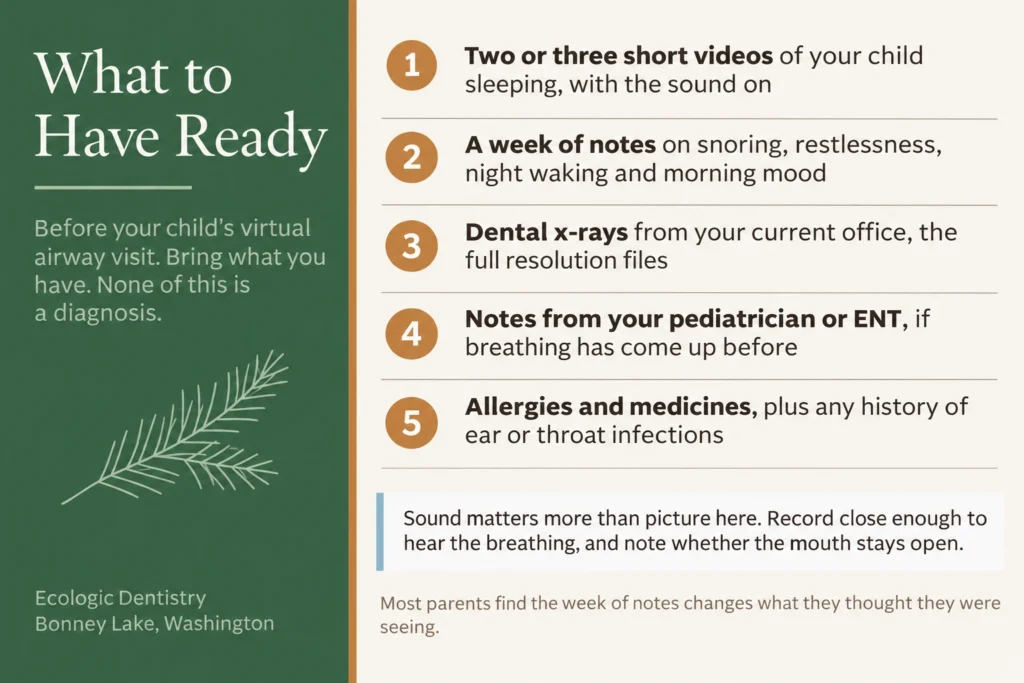
Preparing a few details in advance can help make the appointment more productive. Parents often notice patterns in their child’s sleep and breathing over time, so keeping brief notes before the visit can be more useful than trying to recall every detail during the conversation.
If possible, gather the following:
- Videos of your child sleeping: Two or three short recordings with sound may help illustrate breathing patterns, snoring, or mouth breathing.
- A week of observations: Note any snoring, restless sleep, night waking, unusual breathing sounds, or changes in morning mood and daytime energy.
- Dental records: Provide copies of relevant dental X-rays and other records from your child’s current dental office, if available and requested.
- Medical notes: Include relevant information from your child’s pediatrician or ENT specialist, particularly if concerns about breathing or sleep have already been discussed.
- Medical history: Be prepared to discuss allergies, medications, and any history of recurring ear, nose, or throat infections.
When recording a video, try to capture your child’s breathing clearly without disturbing their sleep. If possible, include enough sound to hear any snoring or unusual breathing noises. You can also note whether your child tends to sleep with their mouth open.
These materials help the dentist understand your observations and identify questions that may need further investigation. They do not replace an examination or a sleep study when one is indicated.
What happens if the findings point beyond dentistry?
Breathing and sleep concerns in children can involve several different areas of healthcare. Depending on the findings, appropriate care may involve a dentist, pediatrician, ENT specialist, sleep physician, or other qualified provider.
For example, enlarged tonsils and adenoids can contribute to airway obstruction and may require evaluation by an ENT specialist. If sleep apnea is suspected, a pediatrician or sleep specialist can help determine whether a sleep study or other medical assessment is needed. When dental or jaw development may be relevant, the dentist can explain those findings and may guide development with oral appliance therapy. This collaborative approach helps ensure that concerns are evaluated from the perspectives needed to understand the child’s situation.
Dr. Carla Yamashiro’s role is to assess the dental and oral development concerns within her scope of practice, explain what the findings may suggest, and recommend further evaluation when appropriate. She cannot determine every cause of a child’s breathing difficulties through a dental appointment alone.
Not every family who seeks a virtual evaluation will need ongoing dental care. Some may benefit from a discussion with their existing dentist or pediatrician, while others may need an in-person dental examination or assessment by a specialist. Recommendations depend on the individual child’s needs.
The priority is to help parents understand the findings and identify appropriate next steps, including working with other healthcare professionals when needed.
Get a clear read on your child’s breathing before you decide
Dr. Carla Yamashiro has practiced dentistry in Bonney Lake for 23 years and has additional training through the American College of Integrative Medicine and Dentistry. She holds an Integrative Biologic Dental Medicine Certificate and a Naturopathic Physician Certificate.
Her approach to children’s mouth breathing and airway concerns considers oral structures and development alongside the concerns parents report about breathing and sleep.
A virtual evaluation offers an opportunity to discuss those concerns, review available information, and understand whether further dental or medical assessment may be appropriate. For some families, it may be a useful first step toward an in-person examination. For others, it may help clarify which healthcare provider to consult next.
If you are concerned about your child’s breathing or sleep, call our Bonney Lake office at (253) 863-7005 to ask whether a virtual evaluation fits your question, or book at ecologicdentistry.com. To learn the signs first, read about the five signs of sleep related breathing disorders. To see how the appointment works, read how teledentistry works in Washington.
Common questions about children’s airway evaluations
How do I know if my child has an airway issue?
Changes in your child’s breathing and sleep may indicate that further evaluation is needed. Signs to watch for include snoring, pauses in breathing, restless sleep, gasping, snorting, coughing, or choking during sleep. Some children also breathe through their mouths during the day, wake with headaches, or experience daytime tiredness or difficulty concentrating.
The Mayo Clinic’s guidance on pediatric sleep apnea describes several of these symptoms. However, symptoms vary, and not every child with sleep apnea snores. The absence of snoring does not rule out a sleep-related breathing problem.
These signs do not necessarily mean your child has an airway disorder or sleep apnea. If you notice persistent symptoms, discuss them with your child’s pediatrician. A dental evaluation may also help identify oral or developmental findings that contribute to sleep related breathing disorders.
At what age does this matter most?
Airway and sleep concerns can occur at different ages, but early childhood is an important period for facial and jaw development. The National Heart, Lung, and Blood Institute notes that obstructive sleep apnea is most common in children between ages 2 and 8, with enlarged tonsils and adenoids being important contributing factors.
However, concerns about breathing, sleep, or oral development are not limited to this age range. Older children can also experience sleep-disordered breathing, and their symptoms deserve attention when present.
If you have concerns about your child’s breathing or sleep, discuss them with their healthcare provider rather than waiting for a particular age or developmental milestone. The appropriate evaluation and next steps depend on the child’s symptoms and individual circumstances.
Why does my child grind their teeth at night?
In kids, grinding usually comes from something in the mouth. The ADA says that with kids, teeth grinding is not usually the result of stress. It lists things that bother the mouth, allergies that make breathing hard, and teeth that do not line up. Dr. Yamashiro starts with the bite. Teeth that do not meet evenly can set off grinding. She asks about your child’s breathing too, because a child working hard to breathe can grind. And she checks if the mouth has enough room for the tongue. Grinding alone does not mean your child has an airway problem. Bring it up at the visit anyway, because a dental exam is where all three of those turn up. If none of them is there, she will say so. Results vary from child to child.
The American Dental Association’s guidance on teeth grinding discusses possible contributing factors in children, including irritation in the mouth, allergies that make breathing difficult, and problems with how the teeth fit together.
If your child regularly grinds their teeth, mention it to their dentist. The dentist can assess signs of tooth wear and determine whether further evaluation is appropriate. If grinding occurs alongside snoring, mouth breathing, restless sleep, or other breathing concerns, share those symptoms with your child’s pediatrician as well. Considering the full picture helps healthcare providers determine whether the grinding is an isolated concern or whether other factors should be investigated.
Does my child need a sleep study?
Some children do, but a dentist does not make that decision alone. A sleep study is ordered when a child’s symptoms, examination, and medical history suggest that sleep-disordered breathing may be present. According to Cleveland Clinic, diagnosis begins with a review of symptoms, a physical examination, and a medical history, and a sleep specialist may then recommend a sleep study called polysomnography.
A dental airway evaluation can help determine whether that conversation is worth having with your child’s pediatrician or a sleep physician. It does not replace a sleep study or a medical referral when one is needed.