

Know What a Virtual Dental Visit Really Gives You
You found teledentistry while looking for answers and cannot tell whether it is real care. Teledentistry means using secure video and digital records to deliver parts of dental care remotely. Dr. Carla Yamashiro, DDS, has practiced integrative dentistry for 23 years. She leads Ecologic Dentistry in Bonney Lake, Washington. She holds an Integrative Biologic Dental Medicine Certificate and a Naturopathic Physician Certificate. Her practice is dentistry, and that additional training shapes how she approaches it. She uses virtual visits with her own patients across Washington.
The worry underneath your search is reasonable. You suspect this is a thin version of dentistry sold as convenience. You do not want guidance from someone whose training you cannot verify. Your mouth is a reflection of your whole body, and we treat you accordingly. That standard holds whether the appointment happens in a chair or on a screen. What changes is which parts of care fit the format. This page shows you where that line falls.
What is teledentistry?
Teledentistry is dental care delivered through secure digital communication. Professional guidance recognizes four distinct forms of it. Each one handles a different part of the care relationship. Live video between you and a dentist. Secure review of records you send ahead. Remote monitoring of information gathered over time. Care supported through mobile devices and apps.
Most consultations combine the first two. You submit images and history, then meet the dentist live to discuss them. The term describes a delivery method, not a category of care. A conversation about your treatment plan stays the same conversation. The chair or the screen does not change what gets said.
Is teledentistry legitimate?
Yes, within limits that credible providers state before you book. The dentist must hold a license in the state where you are physically sitting during the visit. That rule keeps you inside a regulated system with real accountability behind it. Professional bodies have published formal policy rather than leaving the question to individual practices.
Ask the question about a specific provider rather than the whole category. A licensed dentist reviewing your records over video is practicing dentistry. A company mailing you a device with almost no clinician involvement is doing something else. The difference is whether a licensed person reviews your information personally. Someone has to answer for what they tell you.
Who benefits most from a virtual dental visit?
Anxious patients benefit more than anyone, and the numbers make the case. At Ecologic Dentistry, roughly 70 percent of new patients arrive with dental anxiety or a bad experience. A video call lets those patients meet a dentist first. No chair, no light, no instrument tray in view. Below are the situations where virtual visits help most.
- You hold a treatment plan and want the reasoning explained first
- Dental anxiety has kept you from booking anywhere
- You live hours away and want guidance before a long drive
- You are recovering from a procedure and have follow-up questions
- You want a biological perspective on safe amalgam removal or materials
- You are a parent with questions carried over since the last visit
Distance is the second reason people book, and it is a bigger factor than most practices admit. Ecologic Dentistry draws patients from the Olympic Peninsula, north of Seattle, and south through Olympia and Lacey. The furthest travels from Oregon. Reaching a biological approach to dental care often means a serious drive. A virtual first step removes the gamble from that decision.
How does a virtual dental appointment work?
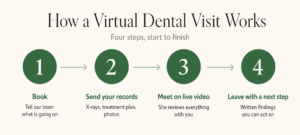
You book, you submit records, and you meet the dentist on live video. Send imaging, treatment plans, history, and written questions ahead. Doing that early changes the quality of the visit entirely. Dr. Yamashiro reads all of it before the call rather than opening files while you wait. Preparation is what separates a real consultation from a screen-share.
On the call the dentist walks through your records alongside your concerns. Findings get explained in ordinary language instead of clinical abbreviations. You identify sensible next steps together rather than receiving a verdict. Nothing gets recommended without the reasoning behind it. You are talking with someone who assumes you have already done reading of your own.
What can teledentistry do, and what needs an office visit?
How much a virtual visit can settle depends on what the dentist sees. A conversation alone produces guidance and options. Add your x-rays, your photos, or a look at your mouth on camera. It becomes an examination. Diagnosis becomes possible at that point, within limits a careful dentist will name out loud. The table below shows where each line falls.
| What you need | Talking only | With x-rays or camera | Needs an office |
|---|---|---|---|
| Understanding your options | Yes | Yes | Not required |
| Reviewing a treatment plan | Yes | Yes | Not required |
| Assessing a specific tooth | Limited | Yes | Sometimes |
| Reaching a diagnosis | No | Often, within limits | For anything unclear |
| Taking new images | No | No | Yes |
| Any treatment or procedure | No | No | Yes |
Teledentistry is non-emergency care by design, and that boundary protects you. Swelling, severe pain, or dental trauma belong in an office, not on a screen. A remote exam never matches what a dentist sees with instruments in hand. Anything ending in treatment starts with an in-person evaluation first. Results vary by person and by what your records happen to show.
What should you look for in a teledentistry provider?
Five things separate a real consultation from a thin one. Check them before you pay for anything at all. The differences sit on the website once you know where to look. Any provider unwilling to answer these has told you something useful. Below is what to verify.
- A named dentist whose license you can confirm in your state
- Clear statement of what the visit does and does not include
- A secure platform rather than a consumer video app
- Records reviewed before your call, not opened during it
- Honest limits, including when an office visit is the right answer
Credentials carry more weight here than in most healthcare decisions. You cannot read a room or watch how someone works with people. What you have instead is training, transparency, and what patients say about the experience. Look at all three before booking anything. Two out of three is thin evidence for a health decision.
Talk With a Licensed Biological Dentist in Washington
Dr. Carla Yamashiro has practiced for 23 years. She has treated children she first saw in utero who are now in college. She holds an Integrative Biologic Dental Medicine Certificate and a Naturopathic Physician Certificate. Her practice is dentistry, and that additional training shapes how she approaches it. She trained with the American College of Integrative Medicine and Dentistry. Her approach to biocompatible materials reflects that background. She explains before she recommends, every time.
Virtual consultations require you to be inside Washington while the appointment takes place. Where you live does not matter. Call Ecologic Dentistry at (253) 863-7005 and our professional team will help you find a time. You can also request an appointment online. Bring your records and bring your questions.
Questions People Ask Before Booking a Virtual Dental Visit
Can a dentist diagnose a problem over video?
No, and any provider claiming otherwise should concern you. A diagnosis requires clinical examination, which cannot happen remotely. A dentist can review your records and explain what they show. You hear considerations nobody has raised with you before. Remote services must match what would be delivered in person. That standard appears in the ADA policy on teledentistry. Treat that limit as honesty rather than a failing.
Is my health information private during a virtual visit?
It should be, and you have a role in protecting it. Providers are required to use platforms with safeguards rather than ordinary consumer video apps. On your end, take the call somewhere private and avoid public wireless networks. Practical steps for patients, including choosing a private location, appear in these federal telehealth privacy tips. Ask which platform a provider uses before you book.
Do I need X-rays for a virtual dental visit?
They help, though you can book without them. Existing images give the dentist something concrete to review rather than a description. Your current dentist can release copies of anything already taken. Imaging follows clinical judgment rather than fixed schedules. That principle is set out in federal guidance on dental radiograph selection. A dentist may recommend updated images before detailed guidance on a specific tooth.
Is teledentistry the same as mail-order aligner companies?
No, and the difference matters more than the marketing suggests. Teledentistry connects you to a licensed dentist who reviews your records and answers to a state board. Direct-to-consumer companies ship devices with limited clinician involvement in your case. Professional policy strongly discourages that model. The reason is the potential for irreversible harm, stated in the ADA policy on direct-to-consumer dental services. Ask who is accountable for the advice you receive.