

A dental second opinion is most helpful when a recommended treatment is permanent, costly, or was not clearly explained to you. This article describes seven situations where a second look is often worthwhile, when one is not needed, how to request your records in Washington, and what to bring so the review is as useful as possible.
Dr. Carla Yamashiro, DDS, has practiced integrative dentistry for 23 years in Bonney Lake, Washington. She holds certificates in Integrative Biologic Dental Medicine and Naturopathic Medicine. Her practice focuses on dentistry, informed by her additional training, with all services and recommendations remaining within the scope of dental practice.
Many people hesitate to ask for a second opinion because they do not want to upset a dentist they have known for years. As a result, they often move forward with treatment they still have questions about. This matters most when the treatment cannot be reversed, such as removing a tooth. About 70 percent of Dr. Yamashiro’s new patients arrive feeling anxious or after a difficult experience at another office, so she understands how hard it can be to ask. A virtual dental second opinion offers a comfortable, low-pressure way to get your questions answered. Your mouth is a reflection of your whole body, and we treat you accordingly.
Which treatment plans are worth a second look?
The cost of a treatment plan is not the best way to decide whether it needs a second look. A more useful question is whether you have symptoms and whether you were shown clear evidence of the problem. For example, a filling on a sore tooth with decay visible on the X-ray is different from four crowns recommended at a routine checkup when nothing was bothering you.
It also helps to consider whether the treatment can be undone. A filling can be replaced later, but a tooth that has been removed cannot be put back, and a root canal permanently changes the tooth. For that reason, it is worth asking questions before permanent treatment begins, even if the first recommendation turns out to be correct.
A second opinion from a dentist who will not be providing the treatment can also give you added confidence. It offers an independent review of the same records, which can help you feel sure about your decision either way.
When should you get a second opinion?
Certain situations come up often in Dr. Yamashiro’s virtual second opinion reviews. Each involves treatment that is difficult to reverse, or a recommendation where the reason was not fully explained. A second opinion may be worthwhile if you notice any of the following:
- A root canal or extraction is recommended for a tooth that has never hurt
- You were asked to sign a treatment plan before leaving the office
- Several crowns or fillings were recommended at a visit where nothing was bothering you
- A tooth is now marked for removal after being described as healthy a year ago
- An implant was suggested before anyone discussed saving the tooth
- Gum surgery was recommended without gum measurements being shown to you
- Your treatment plan changed after the office came under new ownership
If two or three of these apply to your situation, a second opinion is often worthwhile. One alone may not be a concern, because a tooth can change between visits, and a careful dentist will explain that. It is always reasonable to ask to see your X-rays and gum measurements.
When do you not need a second opinion?
Some situations call for prompt care rather than a second opinion. Swelling in the face, a fever with tooth pain, or difficulty swallowing should be seen right away. The same is true for a small filling on a sore tooth when decay is clearly visible on the X-ray.
Routine cleanings generally do not need a second opinion, and neither does a plan you already understand and agree with. Dr. Yamashiro will tell you when the first dentist’s recommendation is sound, which happens often. A helpful review confirms good care as readily as it raises questions. Results vary depending on what the records show.
How do you get your dental records in Washington?
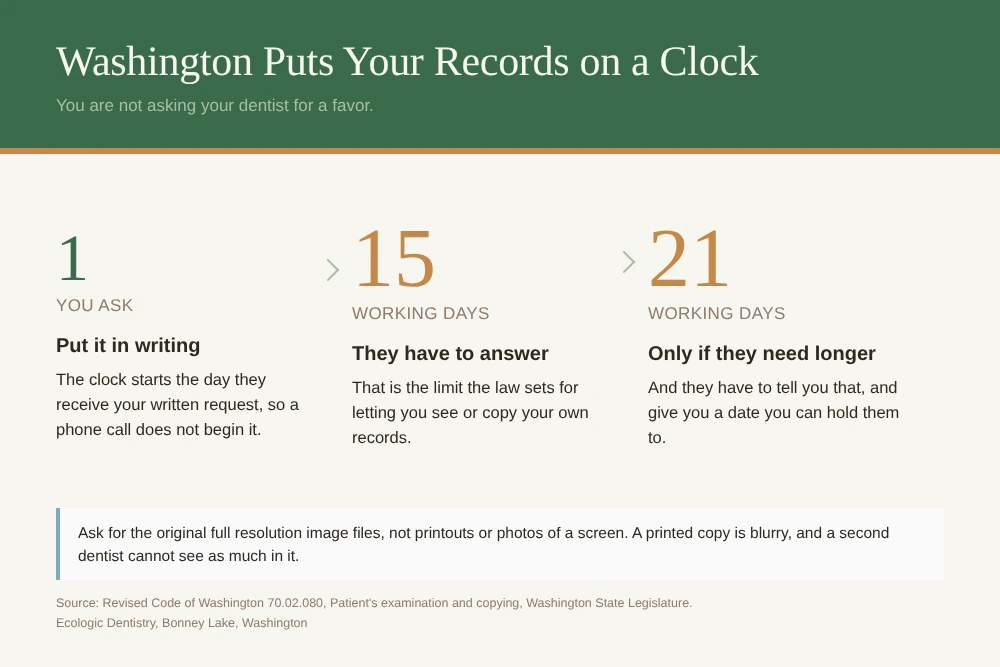
Washington law gives you the right to your dental records. Under RCW 70.02.080, a dental office has fifteen working days to respond to a written request for your records. If the office needs more time, it may extend that period to twenty-one working days, but it must tell you and give you a date when the records will be ready.
It is best to make your request in writing, even if a phone call seems easier, because the timeline begins when the office receives your request. Ask for the original digital X-ray files rather than printouts or photos of a screen. Printed copies are often less clear, which can make it harder for a second dentist to evaluate them.
Keep a copy of your request with the date you sent it. This makes it easy to follow up if fifteen working days pass without a response.
Source: Revised Code of Washington 70.02.080, Patient’s examination and copying, Washington State Legislature, accessed October 21, 2026.
What does each type of second opinion include?
There are three ways to get a second opinion, and each offers a different level of review. Asking your current dentist to explain the plan again is free and quick. A virtual second opinion adds an independent review of your X-rays. An in-office second opinion adds a hands-on exam and new X-rays when needed.
| What you need | Ask your own dentist again | Virtual second opinion | In-office second opinion |
| Have the plan explained again | Yes | Yes | Yes |
| An independent review of your X-rays | Yes | Yes | |
| Written findings you can keep | Yes | Yes | |
| A look in your mouth on screen | Yes | Yes | |
| Hands-on exam and gum measurements | Yes | ||
| New X-rays taken | Yes | ||
| Becoming a patient required | No | No | Yes |
A virtual review can answer most questions about a treatment plan, but it is limited to what your records show. Patients reach Dr. Yamashiro from Puyallup, Sumner, Olympia, and Lacey. Many complete their review without traveling, because written findings to share with their own dentist were what they needed.
What should you bring to a second opinion?
The quality of a second opinion depends largely on the information you provide. A dentist who has your complete records can answer your questions more fully than one looking at a phone photo. Before your appointment, try to gather the following:
- The original X-ray files from the office that made the recommendation
- The written treatment plan or estimate, including the procedure codes
- A note of what you were told, in the dentist’s own words
- When the tooth last hurt, and what seemed to trigger it
- Your medications and health history
- Your long-term goals for the tooth
The last item can make a meaningful difference. A tooth you hope to keep for thirty more years may call for a different approach than a tooth in a mouth that is already changing. Sharing your goals helps the dentist give advice that fits your situation.
How do you get started?
Dr. Yamashiro has practiced in Bonney Lake for 23 years and has additional training through the American College of Integrative Medicine and Dentistry. She holds an Integrative Biologic Dental Medicine Certificate and a Naturopathic Physician Certificate. Her appointments are unhurried, so you have time to ask questions and understand your options.
Whatever the review finds, you will leave knowing what the records show and what your choices are. Call our Bonney Lake office at (253) 863-7005 to ask whether your situation fits a virtual review, or book at ecologicdentistry.com. To learn more first, read how teledentistry works in Washington or her overview of how dentistry affects the rest of the body.
Common questions about second opinions
Can you get a second opinion from another dentist?
Yes, and you do not need anyone’s permission. The American Dental Association notes that complete records allow a new dentist to treat you safely and effectively, which is why your records are an important part of any second opinion. You do not need to explain why you are requesting them. It is best to ask in writing and keep a copy of your request. Results vary depending on what the records show.
Do dentists sometimes overdiagnose cavities?
Two dentists may interpret the same early spot differently, and both views can be reasonable. The National Institute of Dental and Craniofacial Research describes early decay as a white spot where minerals have been lost, and decay at this stage can sometimes be stopped or reversed. Once a cavity forms, the options become more limited. For this reason, monitoring a tooth and filling it can both be appropriate choices for the same tooth. Ask which stage your tooth is in and what the X-ray shows. Results vary by tooth.
What is a red flag for a dentist?
Pressure to decide quickly is the main sign to watch for, because a sound treatment plan holds up well to questions. The American Dental Association lists patient autonomy as one of five core principles of dental ethics, which means the decision is yours to make. Other signs include a plan presented without X-rays, a request to sign on the same day, or nothing provided in writing. None of these alone means something is wrong, but together they are a good reason to seek another opinion.
How much does a dental second opinion cost?
The cost depends on whether the dentist reviews your records or only discusses your concerns, since reading X-rays takes clinical time. The Washington Office of the Insurance Commissioner recommends asking about a plan’s costs, benefits, and exclusions, and your employer can provide your plan booklet. Coverage for a second opinion varies by plan and by procedure. Ask the office for the fee before you book, and what you will receive in writing. Terms vary, so check your own plan.